• Home
  • Crop Map
  • Barnyard Stories
  • Furrow Archives (2009-2010)
  • Farmbedded Archives (2008)

THE FURROW: The online newsletter of Howell Living History Farm

 
The Goose Hisser 04/21/2010
0 Comments
 
Picture
by Larry Kidder
Howell Farm Volunteer

The term “Horse Whisperer” is often used to describe someone who can communicate subtlety with horses.  But, I consider myself to be a “Goose Hisser.”  The Farm’s small flock of Toulouse geese provides an interesting sight when they visit the farmstead on Saturdays.  They are an interesting contrast to the wild Canadian geese that visitors are so used to seeing in this area.  However, these geese are not as warm and cuddly as Maggie the farm dog, Patches the barn cat, or workhorses Mac and Barney, or Jack and Chester, who all like to meet visitors and be touched.  Approaching the geese will most likely bring on loud squawking and hissing as the geese try to intimidate approaching humans.

Several weeks ago I was at my frequent Saturday station at the Phillips Barn when the geese came near the barn entrance.  I walked out to greet them and put them at ease, but all I accomplished was setting up the squawking and hissing.  On impulse I did my best hissing goose imitation directly at the leading goose.  To my amazement, the goose stopped hissing and got a very quizzical look on its face (at least that is my human interpretation of it) and just stood there looking at me.  Then, as I took a couple of steps toward the goose it just stood there.  I was able to walk up to the goose and reach down and stroke it on its head and down the back of its long neck.  The other geese also seemed to calm down and relax.  The geese hung around me for quite a while before wandering off again.

The next Saturday as I walked into the barn yard area the geese came waddling up to meet me.  The one goose that had let me stroke him/her the week before came right up to me and I swear brushed my leg like my cats do in greeting.  Part of the flock stayed with me for much of the morning at the barn door at the end of the horse barn.  It got a little embarrassing because they followed me into the barn and then started to squawk and hiss at visitors who came near me.  I felt like I had a group of four body guards.  My friend stayed by my right side and had no objection to being stroked and then cradled by my hand on his/her wings.  Thankfully, my “guards” decided to move on in mid-morning and I was able to invite visitors into the barn without having to keep the geese away from them.

Fortunately, it appears that geese have relatively short memories and after being away for a couple of weeks things have not been quite the same.  The geese are still pretty calm around me and the one still will let me approach and stroke a little.  The photo accompanying this story was taken on a Sunday when I was at the farm to do grist mill site tours and he/she spent a little time with me.  The day before, though, I caused a goose fight when I got close to my friend and stroked him/her for a few seconds.  Another goose took offense and charged in my direction.  I expected to have to defend myself, but instead the charging goose lit into the goose I had been talking to.  The two geese locked onto each other like two wrestlers locked at the shoulders trying to do a take down.  I actually had to get in between them to get them separated and they apparently settled their differences.  My bruises were only minor.

While I have certainly not spent a great deal of time with the geese, the few experiences I have had have given me some insight into goose culture and I expect to learn more in the future.  I have no idea what I “said” when I hissed back in the initial encounter.  These are a French breed of geese.  When I took French in high school and college I had a notoriously bad accent and had trouble communicating.  My goose accent must be better because the one hiss completely turned around my relationship with this one goose and to some degree the flock in general.  Everyday I spend at the Farm I am amazed by what I learn about the various animals I come in contact with and really value the relationships that have been established – even with a silly goose.
Add Comment
 
Summer and Camp 08/07/2009
0 Comments
 
Picture
by Hannah Mills
Summer Camp Counselor

On Monday morning at 9 a.m., children and adults begin to gather in the “Hatchery” room of the Howell Farm visitor center. It is the first day of another session of summer camp. I watch parents smile, help their sons and daughters hang lunch boxes and book bags on hooks, and then lean in for kisses on the cheek before reluctantly leaving.

That’s when the fun starts.

One activity the campers always seem to love is playing in the creek. How often does a child who lives in the suburbs or city have the opportunity to splash around in a stream? Howell Farm summer camp provides many great outdoor opportunities, but I think the creek may be one of the biggest reasons kids come back year after year.

Crafts are another favorite. The children paint river rocks, create snow globes out of old Mason jars, and sew potholders. Campers love creating their masterpieces, and then proudly present them to parents at the end of the day.

Collecting eggs and leading sheep into the pasture are also popular. Everyone loves homemade ice cream and horse-drawn hayrides. And the animals. Molly, Blaze, and Patches, in particular, are practically celebrities.

The job of camp counselor is very rewarding to me. I love it down to the fragments of laughter, soaked clothing, a small lesson learned from a child, dirt stains, and the sigh of a good but hard-worked day.
Add Comment
 
The Wildness Within 06/13/2009
0 Comments
 
Picture
by Karrin Pearson
Howell Farm Intern

Howell Farm is a place to stroll with children and observe animals grazing in the pasture, working in the field, or playing in their pens. It’s a place to connect with our food sources, our environment, and something I see as deeply human: Wildness. 

This wildness refers not to crazy or uncontrollable behavior but rather to the natural state of things. Wildness lives in our uninhibited or childish ways, in the times when we maintain no boundaries between ourselves and the basic elements of life. When viewed in this light, the farm becomes an even more important place in modern society. For as Thoreau said, “In wildness is the preservation of the world.”  The farm lives history but it also safeguards our future.

Wildness flourishes in every corner here. From the fields of spelt and the babbling brook, to the sugar bush and the early morning rain, its voice whirls through the air. This wildness is easy for us to see; the wheat blows in the breeze, waves ripple in the current, and twisting vines curl themselves tightly around the trees.

These entities act as they naturally do, without thought to any other way of being. Still, it is rather difficult for us to recognize our own inherent wildness in a blade of grass or a splashing wave.  It becomes more apparent when we watch the farm animals.

Our farm animals are not considered wild, in the general understanding of the word. They live in man-made structures, and they are trained, fed, and groomed by our farmers.  However, that's not to say that they don't have personalities or desires and wishes of their own, just like us. In fact, each animal's way of being reflects upon their own innate wildness. They can only be themselves, nothing else.  Blaze, our 31-year old horse, is wild when he shuffles slowly through the grass with bowed head. So too are the goslings when they run forward with flapping wings, or the oxen as they stand still and chew their cud.

When the school children come to learn about farm animals, they are often alarmed that Blaze goes to the bathroom. Giggles erupt and fingers point as the steady stream hits the ground with a rush. But when I ask the young students if they too go to the bathroom, their laughter subsides as they realize Blaze does many of the same things they do. In the horse barn I draw further parallels between horse stalls and bedrooms, sweet feed and honey nut cheerios, and horseshoes and our shoes. When asked if they'd like to live in Barney's stall, the students’ voices resound with "NO!" Yet their grins and eyes widen when I tell them to come in Barney's stall and see what it's like. Their feet stomp and their voices say "nay."

The children enjoy learning how horses are like us. We all should too.  For by recognizing our similarities, we can more clearly see them and ourselves as we truly are – innately wild.
Add Comment
 
An Ode to Manure 04/24/2009
0 Comments
 
Picture
by Karrin Pearson
Howell Farm Intern

My mornings at Howell Farm begin with chores. Although that word may conjure up images of difficult and unpleasant tasks, I see my chores as delightful and meaningful work. One job in particular shines above the rest: shoveling manure. 

I open the door to the ox barn, and am welcomed by Jake’s white horns lurching around the frame of his stall and his shiny dark eyes. Chris, the younger and larger of the two oxen, vocalizes his hunger with a droning moo. I quickly scoop their “cereal” into their bowls; Jake gets a full scoop but Chris only gets a handful. Next I hoist a quarter bale of hay over the railing on either side of the divider, ensuring that Chris won’t steal some of Jake’s needed nutrients. The quiet grinding of their large teeth begins and won’t stop for at least an hour or two. I leave them to their breakfast and turn to other tasks.

When I return to the ox barn, this time from the backside, I open the lower section of the door. The crisp morning light floods inside, brightening Chris and Jake’s dark hides, the yellow straw, and the dark manure that sits on top. As I step onto the cement floor, I inhale the unique combination of sweet dried grass and the earthy, moist, digested grass. Two faces of the same coin.

I’m fascinated by the fact that the ox pies that lie on the barn floor will someday help make food. And I play a key part in that process. By shoveling their manure and adding it to the ever-growing manure pile, I make the first step in recycling their waste into food.  Actually, I shouldn’t refer to the oxen manure as waste, because it really isn’t — it’s farmer’s gold, a key ingredient for healthy soil and crops. 

As I bend forward, pitchfork in hand, my muscles work to carry the heavy manure to the wheelbarrow. I deftly navigate the teeth beneath the pies, trying to leave as much dry straw behind as possible. (Bedding is a precious commodity at Howell Farm, so I must conserve.) The urine-drenched straw is equally valuable, so I slop it into the wheelbarrow. When full, I grip the handles and push the wheelbarrow to the manure pile and contribute the oxen’s daily offering.

Later today, or tomorrow, or perhaps next week, this same offering will fly in the sky as it’s flung out the backend of the manure spreader. It will make one victorious arch and then fall to its final resting place on the soil. With a farmer leading the way, Jake and Chris will pull the spreader back and forth across the field. Both farmer and oxen are physically active in their own food production, contracting muscles, sweating, and breathing quickly.

Farmer and oxen will team up again to sow their crops and then later to harvest them. They are linked in a symbiotic relationship. Together, with the help of the soil, man and animal work to grow food. As soon as the process is complete, the cycle begins anew, recycling the nutrients between the oxen, manure and crops.

I am grateful to be part of such an ancient and sustaining relationship.

Add Comment
 
A Winter Swim 01/23/2009
0 Comments
 
Picture
by Maren Morsch
Howell Farm Intern

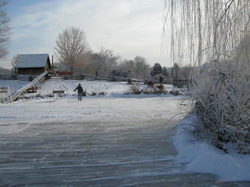
The very first public program I had the opportunity to participate in was January's ice harvest. An impressive igloo, a loaded icehouse, a tired bobsled team, and a lot of ice candles were among the day's results. On the whole, the event was a new experience for me from beginning to end.

I was especially impressed by the enthusiasm of a number of the visitors. There were those who showed up at 9:45 a.m. to be the first ones out on the ice, who harvested for hours as if it was their own family farm they were working for, and who left reluctantly only after it was announced several times that the farm was closing. I can only anticipate that this same energy will be found in other programs I experience as my internship progresses.

Also noteworthy is the “polar bear plunge” I took that day. The combination of a sunny day and large number of people working out on the ice caused a great deal of the ice to soften and “go bad” or “get rotten.”

I thought that the odds were against me falling in, as only a handful of staff members have ever done so, and the running favorite for such an act was an employee whose reputation as a bit of a daredevil led me to feel a false sense of security in the distribution of the odds in this regard. Yet, while helping a child learn how to use an ice saw, I suddenly found myself floating away from the saw, and sinking rather rapidly. The child and his father were on firm ice, but I had been close to the edge, and I soon found myself wallowing waist deep in the chilly water.

After climbing out of the pond, I made my way to the farmhouse, where a combination of quick thinking, ingenuity, and clothing donations from the ladies tending to the hungry stomachs of visitors and staff alike had me dried off, re-dressed, and back out into the action in record time. (Thanks again to everyone who helped!)

Even though the untimely swim put my cell phone out of commission for a few days, and I just today returned the last of the borrowed clothing to its rightful owners, I can’t say it dampened my ice harvesting spirit in any way other than physically. I suffered no injuries — although for the remainder of the day people charged me with duties like tending the fire and going for bobsled rides.

In the end, I had a great story to tell my friends when I got back to school that afternoon. While I don’t necessarily recommend swimming in January, I certainly don’t feel it in any way tainted my first programming experience here.

Add Comment
 

    About

    The Furrow is the online newsletter of The Friends of Howell Living History Farm. We will be updating this site about once a week with crop reports and other insights into life on a horse-drawn living history farm.

    Howell Farm is owned by Mercer County and operated by the Mercer County Park Commission.

    Archives

    April 2010
    August 2009
    June 2009
    April 2009
    January 2009

    RSS Feed


Create a free website with Weebly